The Three Waves of Volunteers and the New Earth
By Dolores Cannon | Reading Notes & Commentary
What This Book Is
40 years of past-life regression sessions. Thousands of clients. A consistent pattern: souls from higher dimensions volunteered to incarnate on Earth starting after WWII (1945) to help humanity navigate a critical transition.
The author is Dolores Cannon, a hypnotherapist. The content comes through clients in deep hypnotic trance. Make of that what you will.
The Three Waves
Three cohorts of volunteers, arriving in sequence:
The pioneers. Most difficult incarnation. They arrived when Earth's technology was most primitive relative to the spiritual knowledge they carried. Symptoms: severe distress at violence, homesickness for "somewhere else," high suicide rates despite external success.
The beacons. Their job: affect people by being present. Generate an energetic field that shifts consciousness just through proximity. Paradox: strongest in crowds, but deeply introverted—they isolate to avoid overstimulation, which defeats their purpose.
The prepared ones. Born with DNA already adjusted for the transition. Often diagnosed as ADHD—actually advanced consciousnesses in bodies that move slower than their minds. Called "the hope of the world."
How They Got Here: The Imprinting Theory
New souls to Earth can't function without reference material. So before incarnation, they visit "the Library"—where all knowledge is stored (Akashic Records)—and select lifetimes to be imprinted onto their soul.
These imprints feel real. They create memories, emotions, reference points. But they're overlays, not lived experience. This explains why multiple people claim to be the same famous person in past-life regression.
The Case of Judy: The Queen Who Left Her People
Judy comes in with physical problems. Cannon hypnotizes her. What emerges:
- Judy remembers being a queen/princess leading thousands of her people
- She is leaving them voluntarily for a mission
- The mission: find missing pieces to complete a cycle
- She doesn't want to leave. There is profound love and loyalty to her people. But it's necessary.
What Cannon calls "the subconscious" (SC) then explains:
The ET Layer: Eleanore and the Maintenance Work
When Judy goes deeper, she remembers childhood "abductions." But they're not traumatic. An ET being named Eleanore is doing maintenance work—monitoring, small repairs, adjustments.
Cannon's interpretation: Judy signed up for this. Interaction with ETs is part of the assignment. They're not harming her; they're helping her complete her mission.
D: "Is that good if you have someone watching you and taking care of you?"
J: "Yes. Confusion comes from poor consciousness. All assignment to this location required interactions. Species are benevolent. It is utilizing humans for their purposes. It is a joint contract. Unable to process this information. They are learning from the human species. They are in agreement. Appearances are often misunderstood. Great misunderstanding. Completion between species is part of her assignment."
Pages 275–277: Patricia's Mission — Symbols & Consciousness
Patricia is told it's time to know her purpose. The beings explain what they want from her:
- She is frustrated that humans have limitations, don't love each other, wage wars
- They have "spiritual laws of the universe" and want her to understand that humans can change
- They have a "book of symbols" and want these symbols to come to Earth
- When people look at these symbols, the symbols change their consciousness
- The symbols carry only peace, light, and love—no negativity
- They want her to write down these symbols and later write words/books to tell people about "the good things that they can do to one another"
Patricia also notes she's young (in the childhood regression) and her vocabulary isn't sufficient yet to explain what they're showing her. The implication: this knowledge comes through childhood encounters and is held until she's mature enough to articulate it.
Pages 290–291: The Craft Encounter & Body-Consciousness Separation
The narrative shifts to Patricia describing how she gets taken by ETs:
They can alter her body's molecular structure so she can pass through walls or ceilings into the craft. She can't go physically because she wouldn't fit through.
P: "Sometimes they've taken me out of my car. Because when I'm in my car, I'm in a different state of consciousness... they can come in and get me and still be driving the car, and yet they can work on my body."
P: "It's my conscious mind that is doing something else, and they can come in and affect my body because I'm hooked up to the computer."
Patricia describes seeing what appears to be a "shell" or "piece of energy" left behind in her bed while her consciousness is elsewhere:
The mechanism remains unclear, but the implication is consistent: consciousness can be separated from the physical body, moved, worked on, and returned without the waking mind remembering.
Tonight's Reading: Two Layers Revealed
These pages do two things simultaneously:
- Define the mission: Patricia's role (and by extension, Wave One volunteers' roles) is to receive and eventually transmit symbols that shift human consciousness toward peace and love
- Describe the mechanism: How ETs operate without the waking mind's knowledge—by separating consciousness from body, altering molecular structure, and hooking into some kind of monitoring system ("the computer")
What We're Tracking
As we read further:
- Species consistency: Do the same ET types keep appearing?
- The mission pattern: What do volunteers actually need to do on Earth?
- The transition: What is Earth changing into? (Part Three)
- Your own resonance: Which stories hit? Which ones feel true, forced, or something else?
- Contact framing: When a being seems caring, how much of that is comfort, and how much is interpretation?
- Reciprocity: If ETs are learning from humans too, what exactly are humans providing?
Pages 280–291: The Craft Encounter, The Nurse Beings & The Implant
Patricia's regression reveals layers beneath her original UFO sighting memory. What she consciously remembered as a beautiful large craft with swirling red and blue lights becomes something stranger under hypnosis.
Conscious: A huge craft with swirling red and blue lights
Hypnotic: A small, transparent, glass-like ball, about 5 feet across, "like a Christmas ball," shimmery and see-through, with a little top like a tree ornament
Dolores notes that in other cases, UFOs can look small from outside yet be much larger inside — as if size and space itself can be manipulated.
P: "There are beings watching me from the craft. The only thing I can see are eyes. They're up in the sky and they've been watching me. And they're not gonna hurt me, they're just watching."
Patricia feels their presence and says they told her they had been watching her before.
Beings enter through the window while she lies in bed (after scarlet fever). She describes them in vivid detail:
- Reddish-looking eyes
- Wrinkled looking face
- No neck — kind of hunchbacked
- About 5.5 feet tall
- Strange looking, "they don't look right"
- She says: "He looks like an old goblin" with thick fingers, big and ugly
Dolores has encountered this type many times and calls them "nurse" beings. Unlike the little greys (described as robotic, mechanical, emotionless), these beings:
- Show more compassion
- Seem to think for themselves rather than automaton-like
- Are always described as wrinkled, ugly, but very kind
- Perform care and comfort functions rather than clinical procedures
P: "He's doing something to my little night clothes, unbuttoning my night clothes. It's like a doctor. Just checking me out. He wants to make sure that the functions of my body are operating properly."
The being applies pressure to her chest and sends "vibrations or something" through her body. Patricia remembers having Scarlet Fever when young and her mother told her about it, but she didn't remember the illness itself.
P: "He wants to make sure that I'm okay. Vibrations or something go up and he knows if I'm okay."
D: "When did they do that?"
P: "When I was born. They put something in my body when I was born."
D: "What part of the body is it in?"
P: "Let me see. It seems to be something up around my pituitary gland. Something up around my forehead. They put in there, like a chip or something. It's like glass, but I don't think it's glass. I don't know what it is. I don't know if the man did it; maybe one of his friends did. I watched them put it in. They did it before I jumped into my body."
The implication: Pre-incarnation awareness. She watched them insert something before her consciousness entered the body.
Dolores's Explanation: The Protective Memory Overlay
Dolores explains that Patricia's subconscious apparently created a protective screen memory so she would remember the experience differently and not be traumatized. The beautiful large UFO with red and blue lights may have masked the stranger reality.
Dolores notes that this protective mechanism is often done to prevent trauma, but sometimes the subconscious thought it was time for the real memory to come through with no blocks—allowing Patricia to remember the actual event now.
The Larger Pattern
These pages reveal a sophisticated multi-layered system:
- Pre-birth insertion of a device (possibly for tracking/communication)
- Childhood contact framed as medical care/health maintenance
- Gentle, caring beings ("nurses") who perform the contact
- Memory manipulation by the subconscious to protect the individual
- Later recall under hypnosis to restore the original event
The implication: Patricia consented to this at a soul level before incarnating. The implant is part of her assignment. The "nurse" beings are caregivers, not captors. But the memory protection suggests the waking mind is being shielded from knowing the full extent of the contact.
Page 292: Symbols, Crop Circles & Subconscious Transmission
The conversation turns to crop circles as a communication medium — not to human intellect, but to human consciousness itself.
P: "The circles are a language that is understood on the subconscious level. The symbols are pure divine light and peace and harmony."
P: "People don't have to understand the symbols? They just have to see them. They go into the subconscious mind. The subconscious mind is all knowing."
Pages 296–300: Beings of Light, Divine Purpose & the No-Negativity Claim
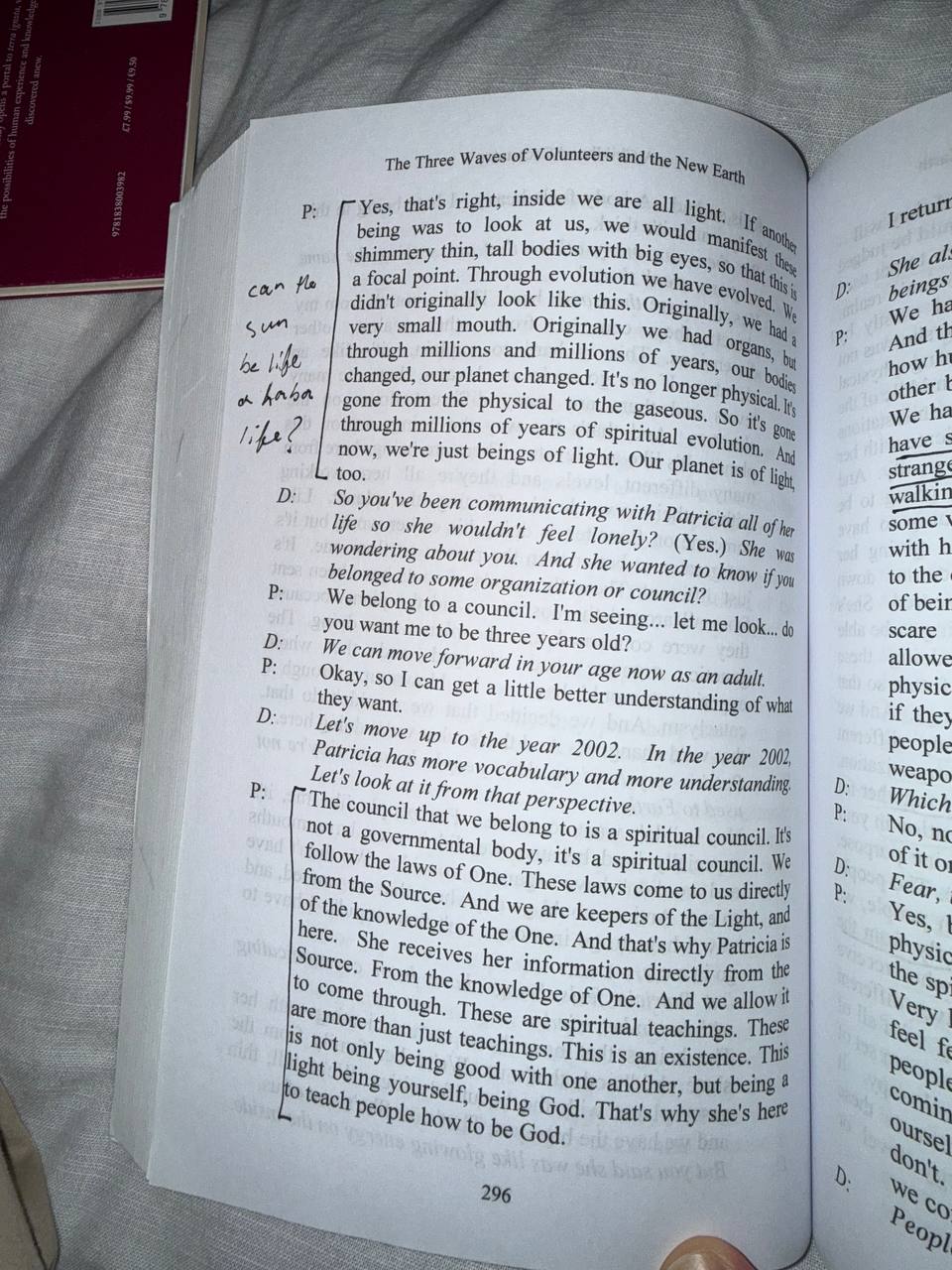
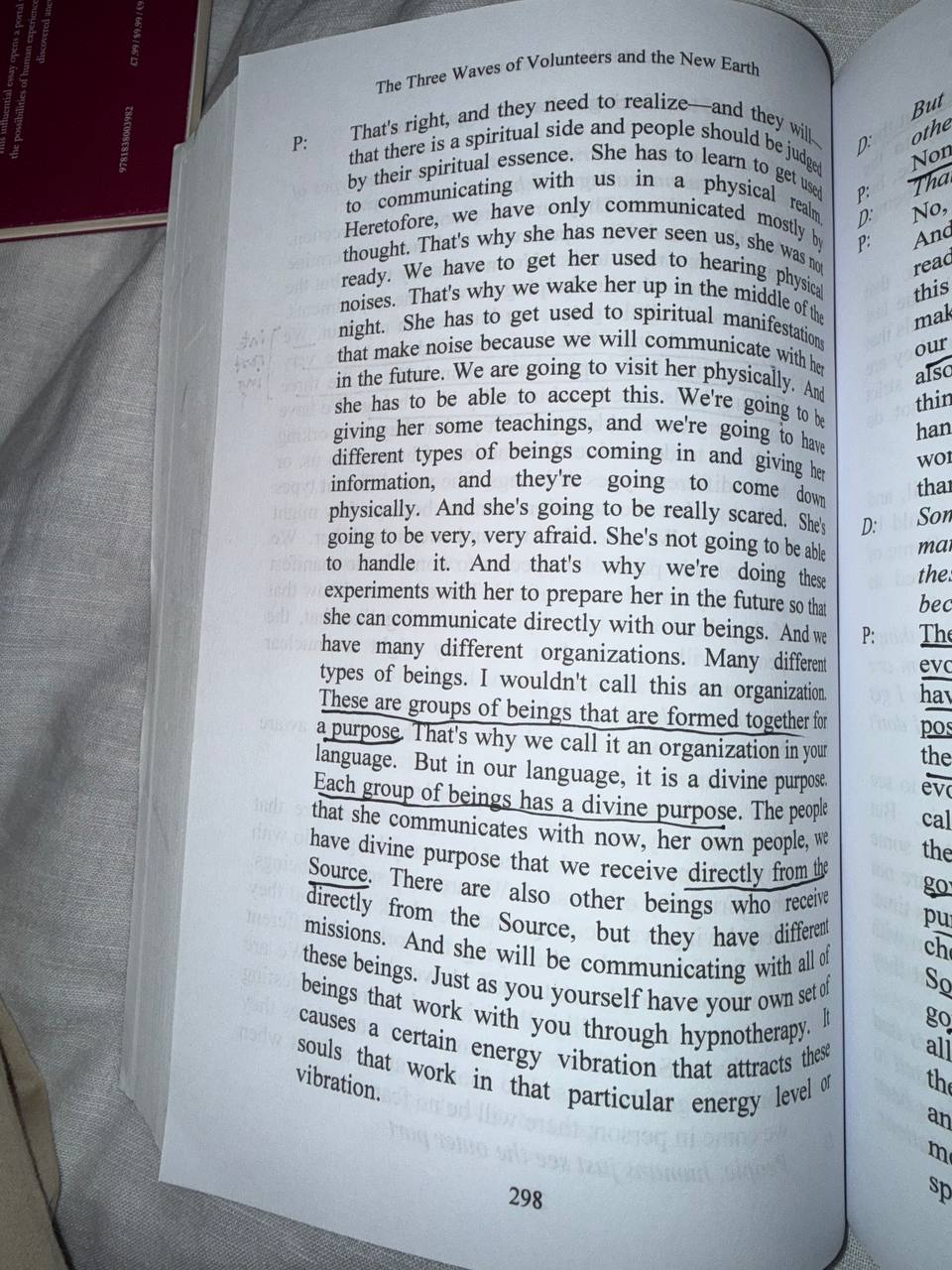
This stretch sharpens the cosmology. The beings describe themselves less like a government and more like a spiritual council aligned with what they call "the laws of One." They say Patricia's work is about carrying knowledge directly from Source, and that many classes of beings exist with different roles, missions, and levels of development.
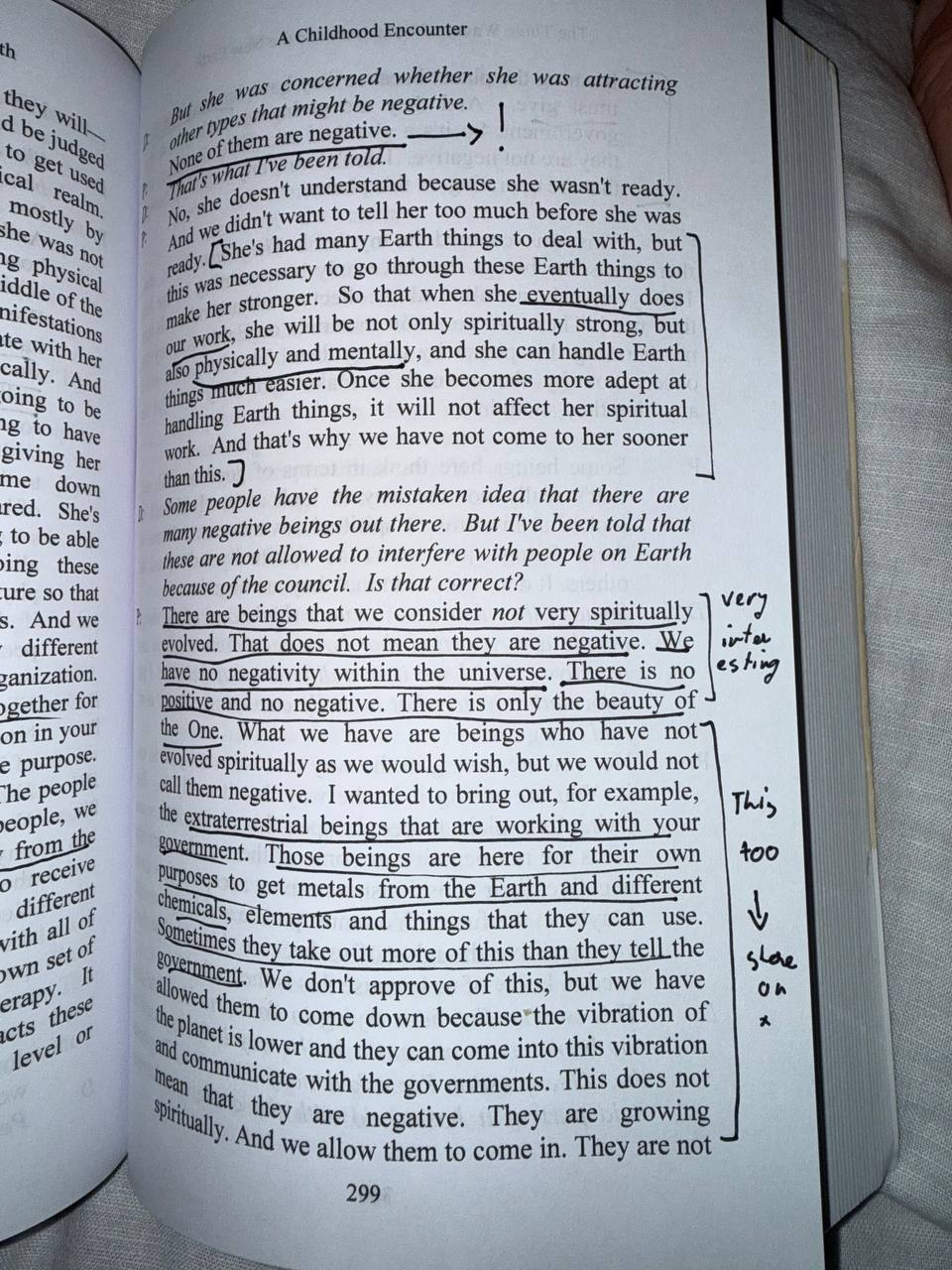
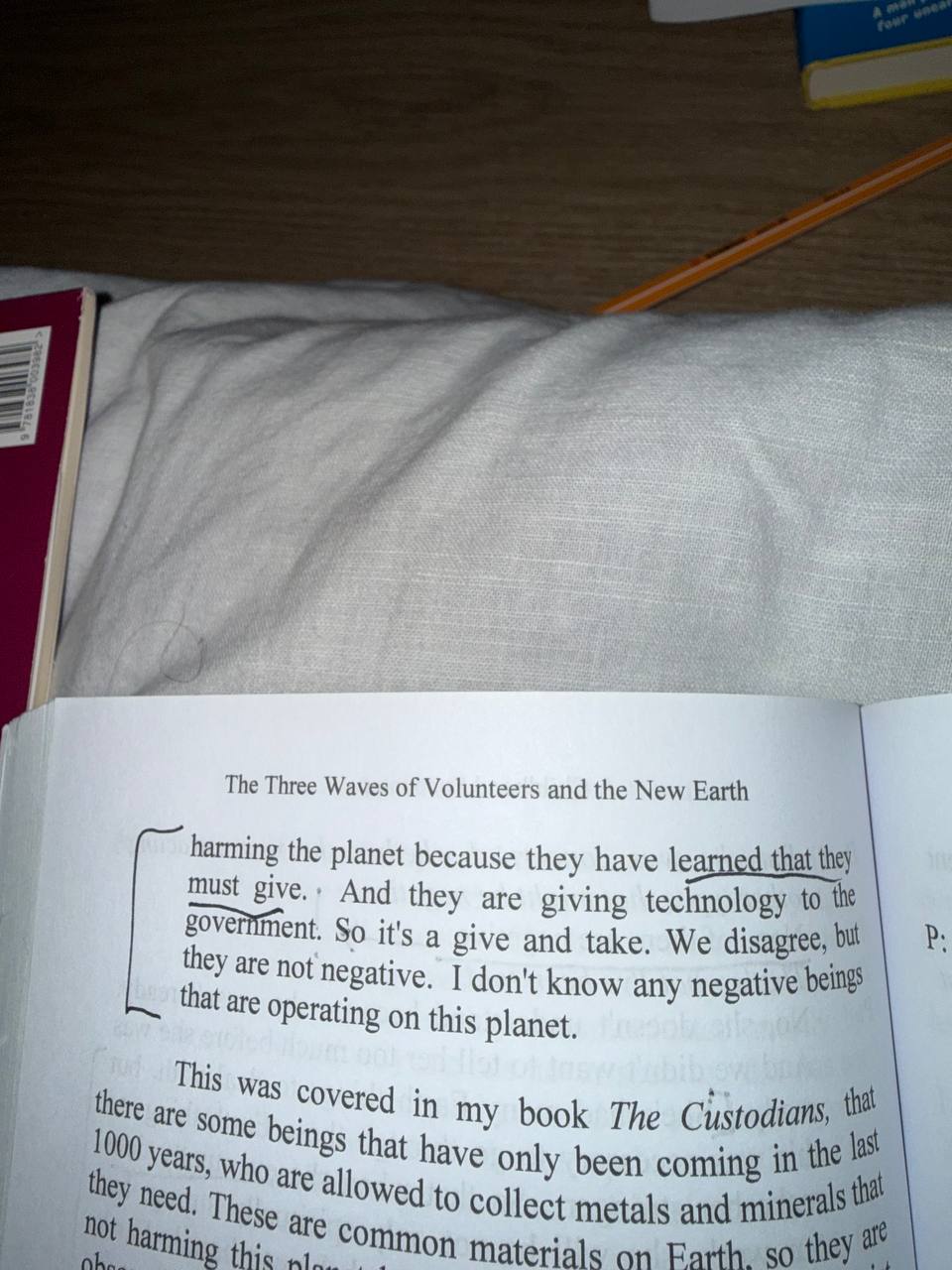
The most provocative claim is not just that there are many beings — it is that none are truly negative. Instead, the text frames lower or rougher beings as less spiritually evolved, mission-bound, or operating within limited exchange relationships with governments and Earth systems.
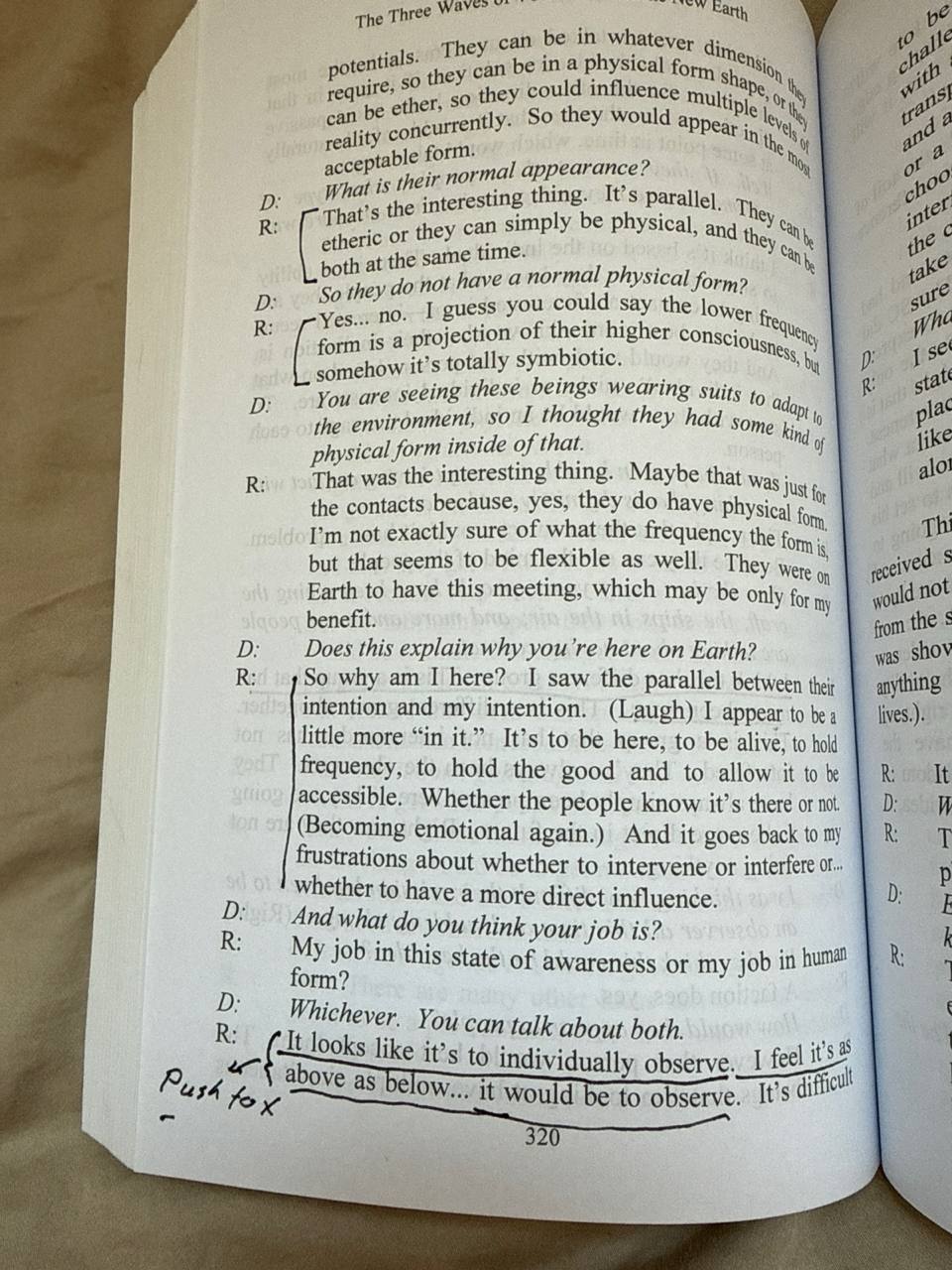
Pages 317–320: The Free Will Catch-22 & Holding Frequency
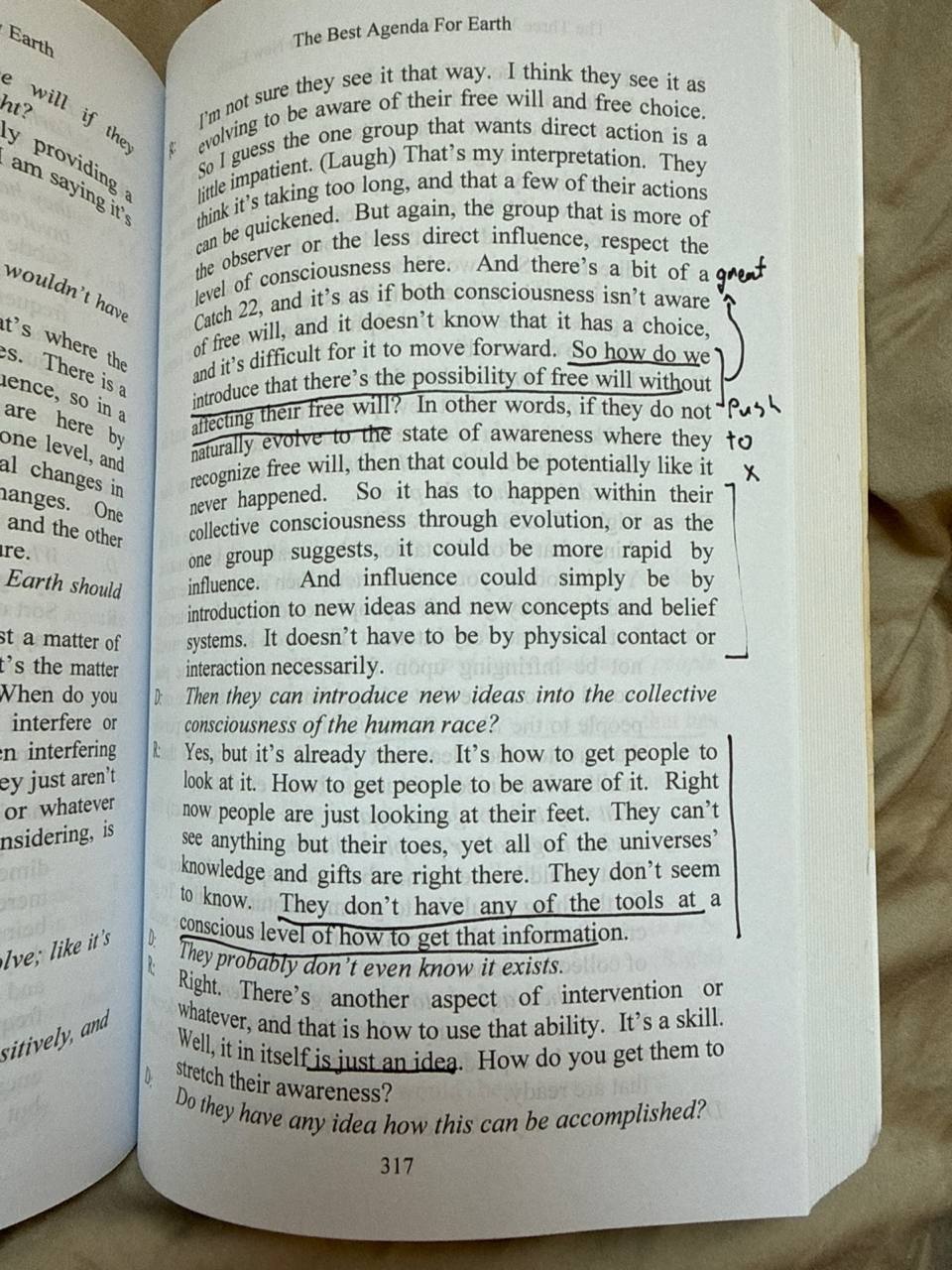
These pages surface what may be the most precise statement of the whole book's underlying tension. There are two factions of beings — one that wants to accelerate human evolution through influence, one that insists on pure non-interference. The impasse is structural: how do you introduce the idea of free will without violating the very thing you're trying to introduce? If humans don't naturally evolve to recognize free will on their own, it's as if it never happened. But the patient observer stance risks leaving people "looking at their feet" while the universe's full bandwidth sits right there, invisible.
Page 317 lands on a sharp diagnosis: it's not that the knowledge is hidden — it's that humans lack the conscious tools to access what's already present. All of it is there. The gap is perceptual, not informational.
Page 320 shifts to the personal. The speaker asks themselves what their own job actually is — in higher awareness, and in human form. The answer is deceptively quiet: to be here, to hold frequency, to hold the good and allow it to be accessible, whether people know it's there or not. Not intervention. Not broadcasting. Just presence as signal.
Pages 322–323: Intention, Manifestation & Self-Limiting Belief Systems
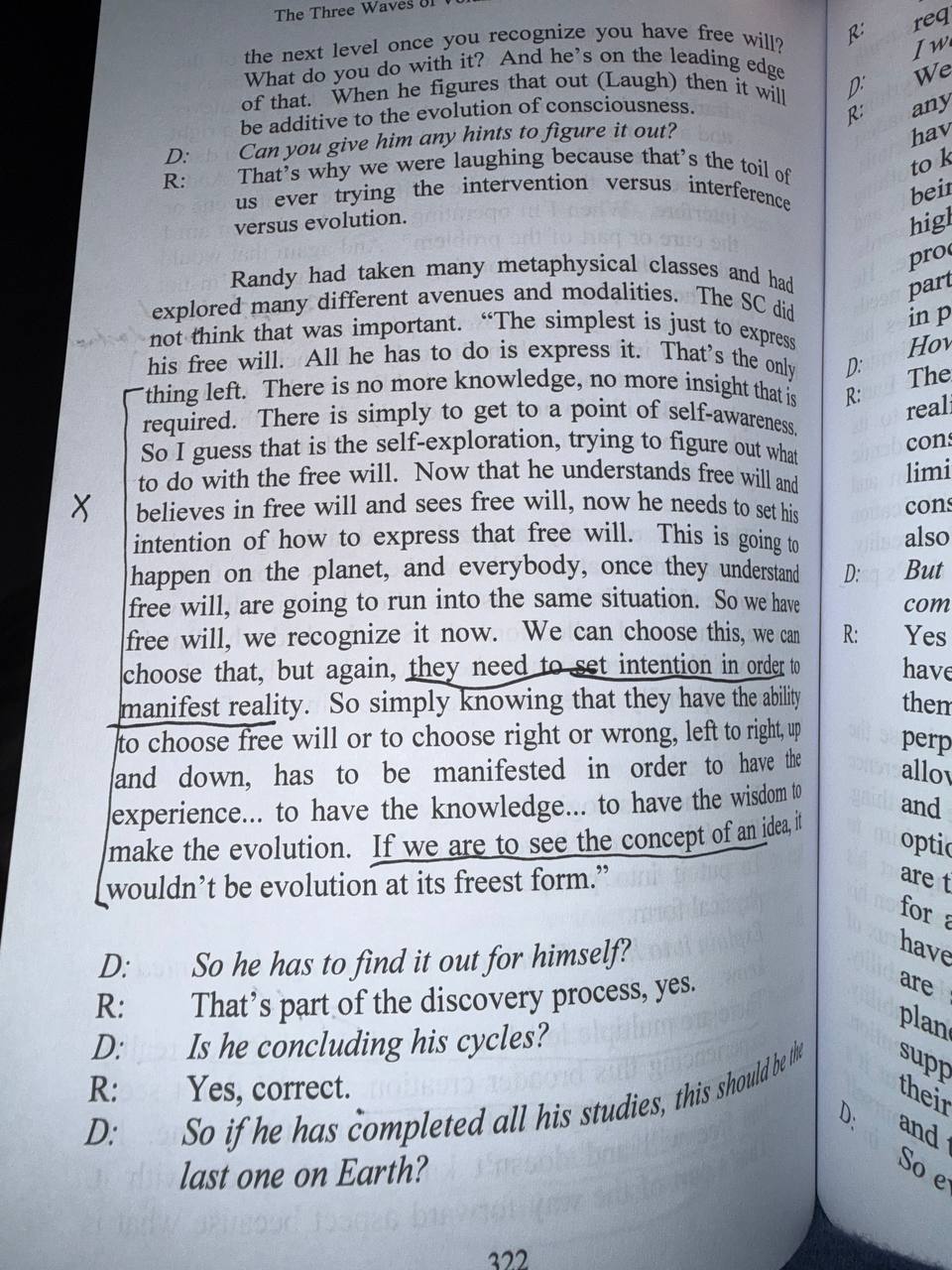
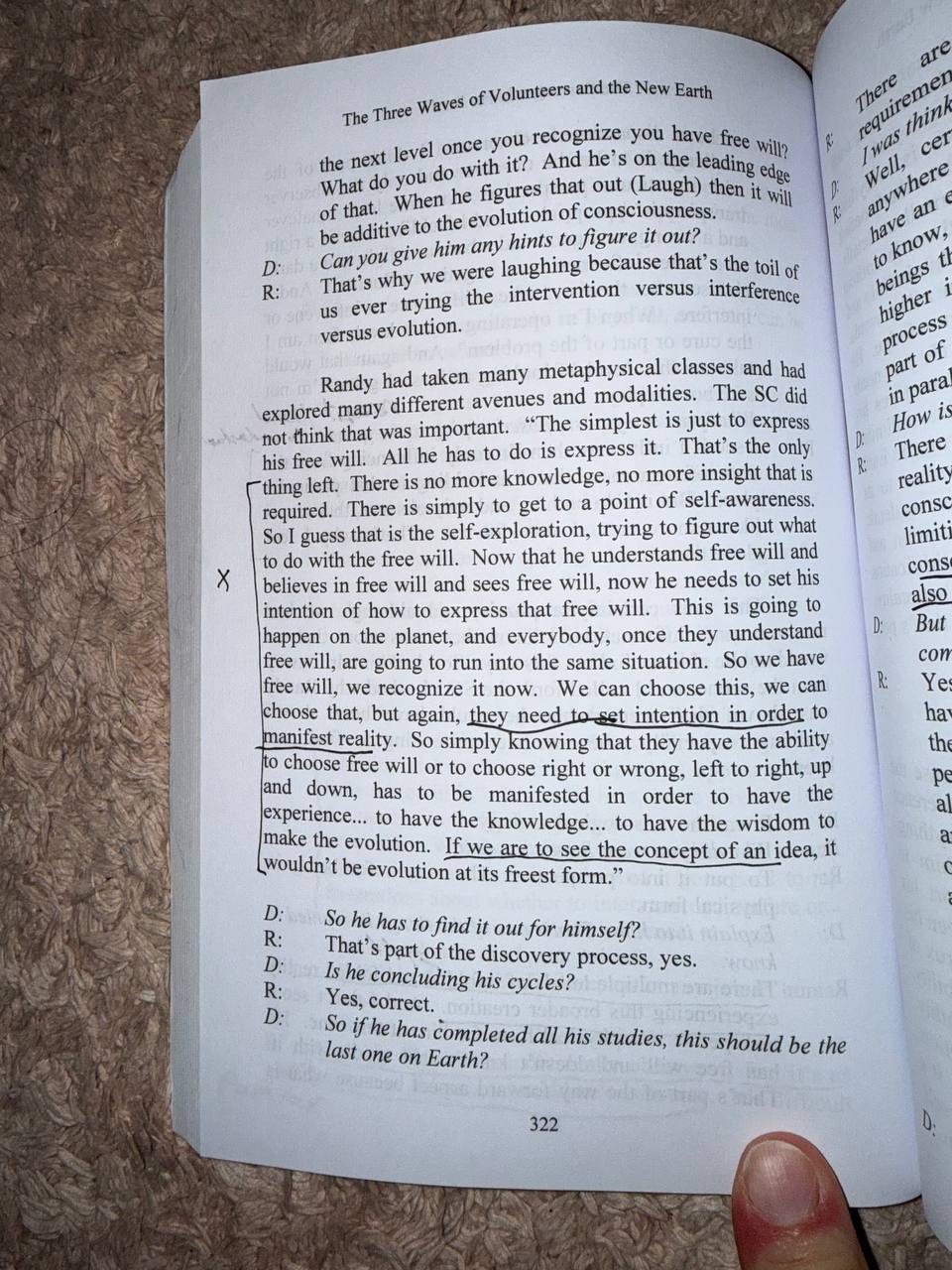
Page 322 closes the free-will loop with a practical hinge: understanding free will isn't enough — you have to set intention to manifest reality. Knowing the option exists and actually operating from it are two different states. The book frames this not as philosophy but as mechanics.
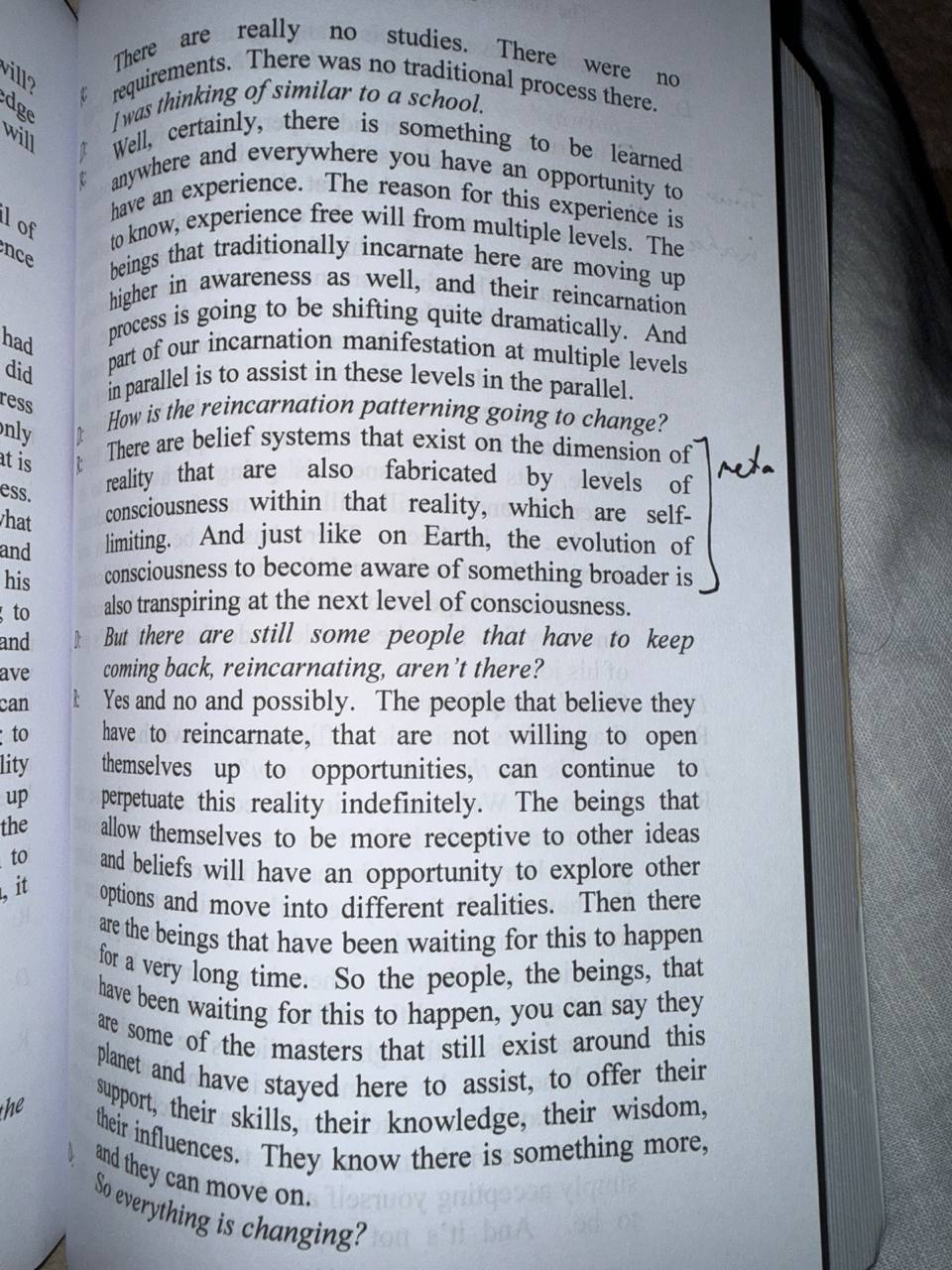
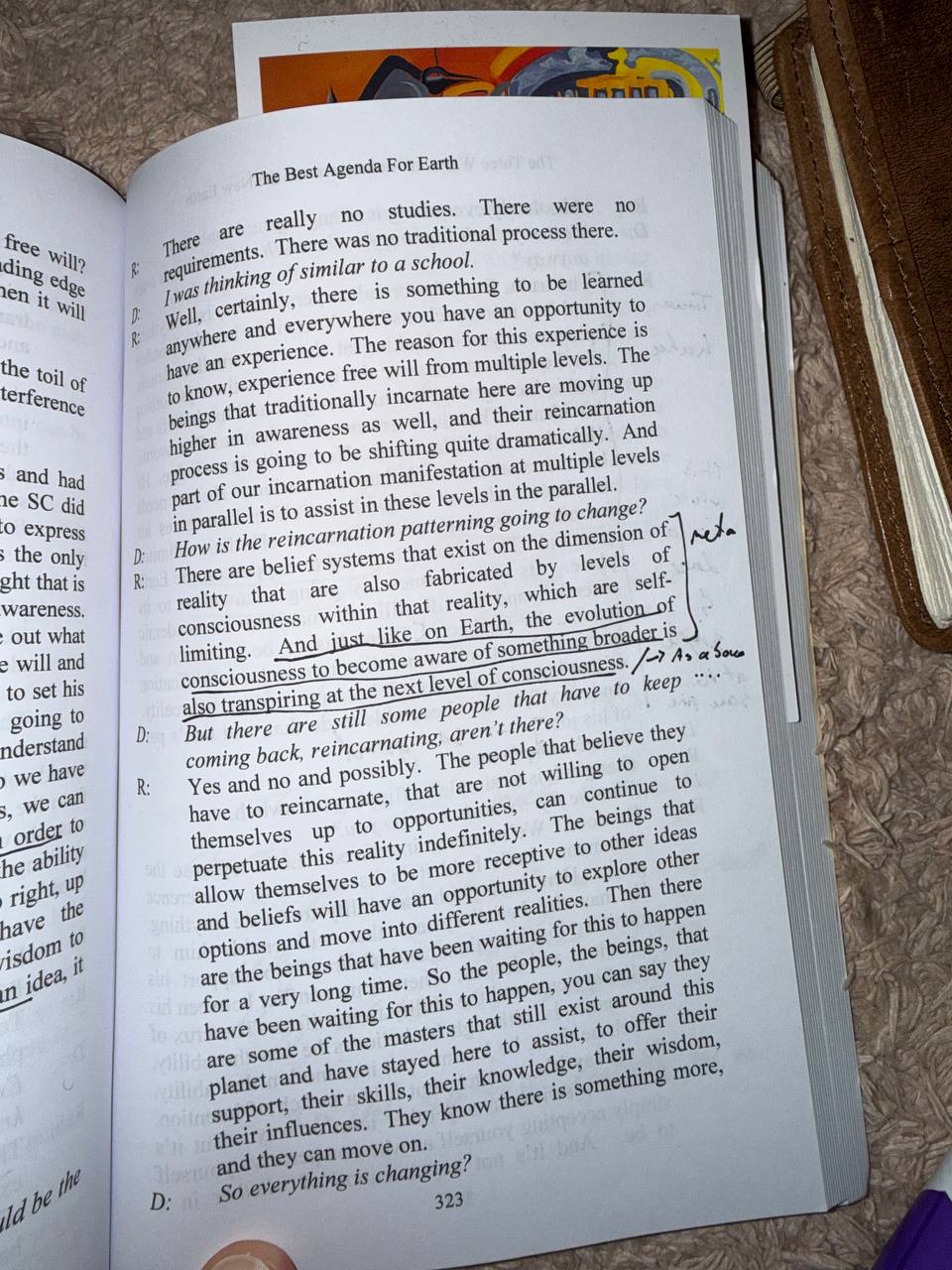
Page 323 steps one level up. The speaker describes belief systems that exist on a dimension of reality fabricated by levels of consciousness within that reality — which are self-limiting by design. This is the architecture of containment from the inside: the walls are made of the same material as the mind that built them.
Highlights / Resonance Bucket
This is the new running bucket for what your consciousness grabbed in the margins — brackets, underlines, circles, arrows, side-notes. Not just what the book says, but what you noticed yourself noticing.
"There are belief systems that exist on the dimension of reality that are also fabricated by levels of consciousness within that reality, which are self-limiting."
Marked "meta." This passage captures the architecture of consciousness reflecting on itself. We are building the very belief systems that contain us.
"Yes, that's right, inside we are all light... And now, we're just beings of light. Our planet is of light, too."
Resonance: identity beneath form. This is where the question surfaced: can light itself be a mode of life?
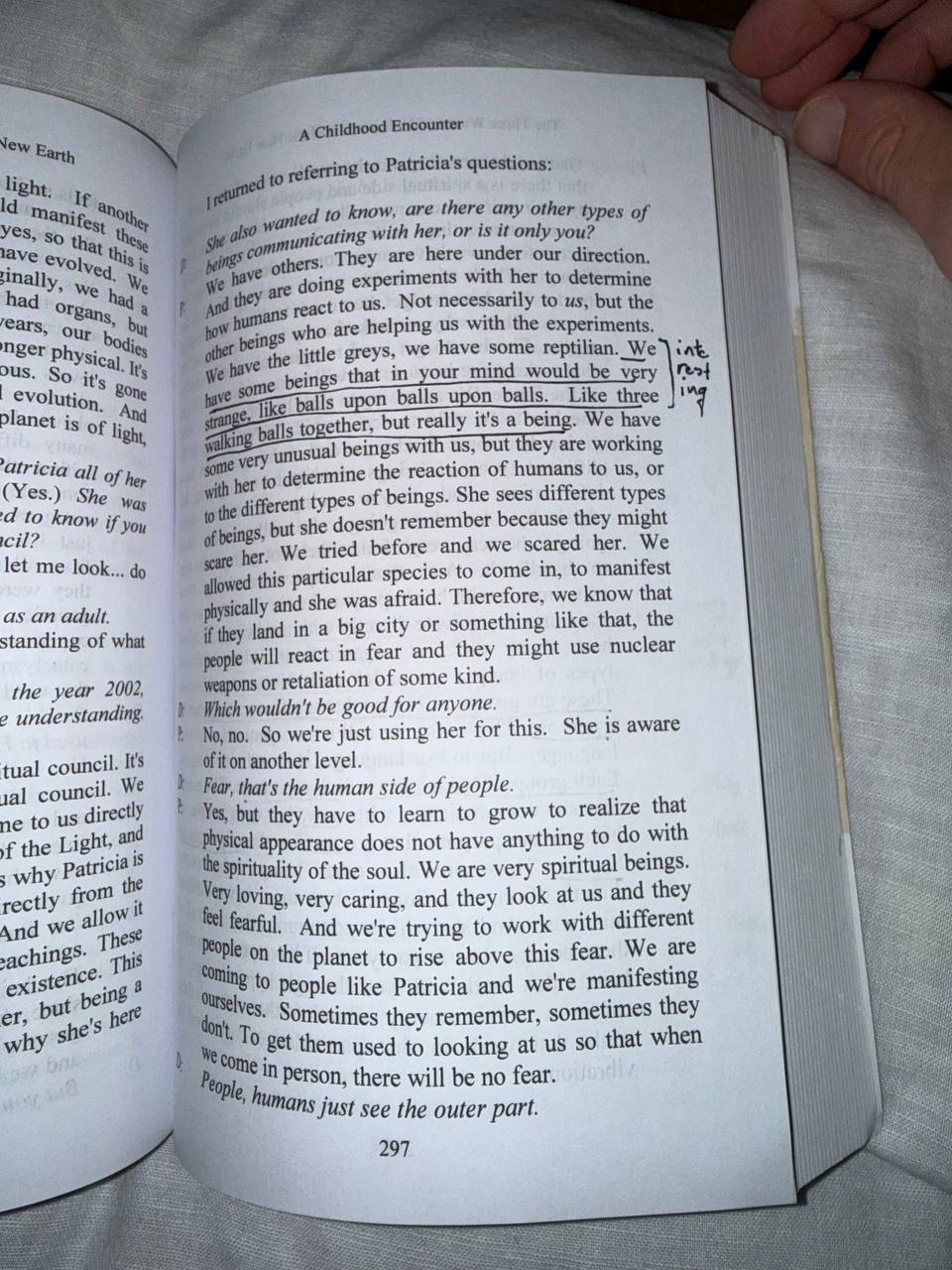
"We have some beings that in your mind would be very strange, like balls upon balls upon balls. Like three walking balls together, but really it's a being."
Resonance: intelligence may not map cleanly onto humanoid expectation. The margin note here points toward radical morphology.
"These are groups of beings that are formed together for a purpose... Each group of beings has a divine purpose."
Resonance: organization here is framed as mission-pattern, not bureaucracy.
"There is no positivity and no negativity. There is only the beauty of the One."
Resonance: this is one of the strongest ontological claims in the whole section — not moral dualism, but degrees of development inside a larger unity.
"There are beings that we consider not very spiritually evolved. That does not mean they are negative... There is only the beauty of the One."
Resonance: this was the bracketed passage marked "very interesting" and tagged for X — a cleaner statement of development without demonization, and difference without cosmic enemies.
"Those beings are here for their own purposes to get metals from the Earth... We disagree, but they are not negative."
Resonance: conflict without demonization. Extraction is acknowledged, but the frame refuses the simple good/evil split.
"But, yes, it's already there. It's how to get people to look at it... Right now people are just looking at their feet. They can't see anything but their toes, yet all of the universes' knowledge and gifts are right there. They don't have any of the tools at a conscious level of how to get that information."
Resonance: the knowledge isn't missing — the perceptual tools are. The intervention problem isn't informational, it's structural. You can't give someone the tools to see what they can't yet see without bypassing the very faculty you're trying to develop.
"It looks like it's to individually observe. I feel it's as above as below.... it would be to observe. It's difficult."
Resonance: holding dual frequency — higher-awareness observer and human form — simultaneously. The job isn't intervention or broadcasting. It's presence as signal: hold the good, allow it to be accessible, whether people know it's there or not.
"They need to set intention in order to manifest reality."
Resonance: knowing free will exists and actually operating from it are mechanically different states. This is the hinge between understanding and embodying — the book frames it as physics, not philosophy.
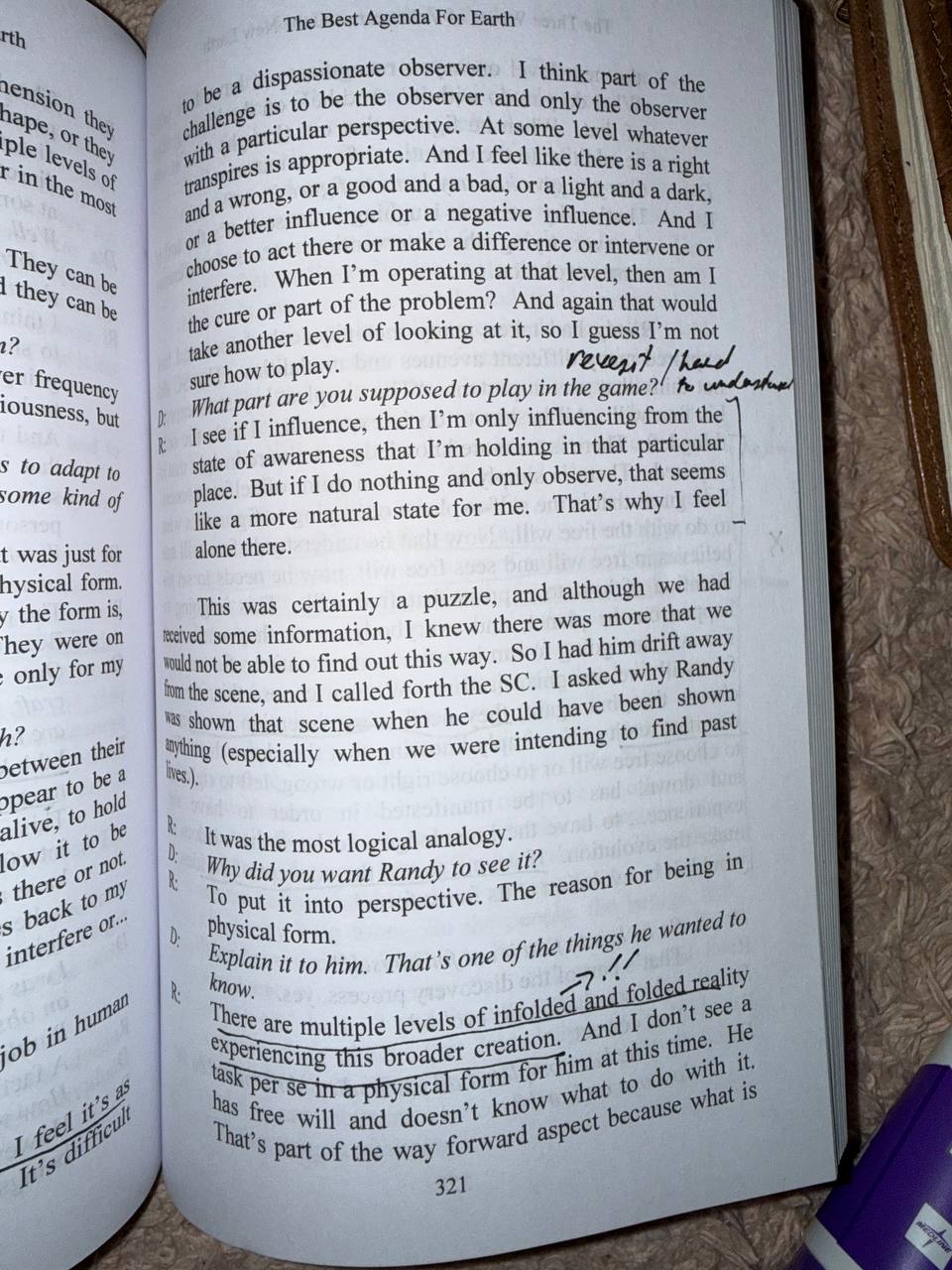
"What part are you supposed to play in the game?"
This quote highlights the reader's contemplation of active participation versus passive observation within a grander scheme. The handwritten notes suggest a difficulty in grasping this concept.
"There are multiple levels of infolded and folded reality experiencing this broader creation."
This quote points to the complexity of existence beyond a single linear reality, suggesting multiple dimensions or states of being that impact the individual's experience.
"task per se in a physical form for him at this time."
This quote directly addresses the purpose of physical embodiment, prompting reflection on the specific task or lack thereof assigned to an individual in this form.
"D: Can you give him any hints to figure it out?"
This quote highlights the difficulty of guiding someone's self-discovery, especially when it comes to fundamental concepts like free will and its implications.
"But again, they need to set intention in order to manifest reality."
This emphasizes personal agency and the power of conscious choice in shaping one's experience and reality, moving beyond mere recognition of free will to its active use.
"If we are to see the concept of an idea, it wouldn't be evolution at its freest form."
This suggests that true evolution arises from the unconstrained exploration and application of ideas, implying that any form of restriction or external influence stifles this natural, free progression.
"consciousness to become aware of something broader is also transpiring at the next level of consciousness"
This quote highlights the idea of expanding awareness beyond current limitations, suggesting a progression of consciousness not just individually, but possibly collectively or at higher levels of existence.
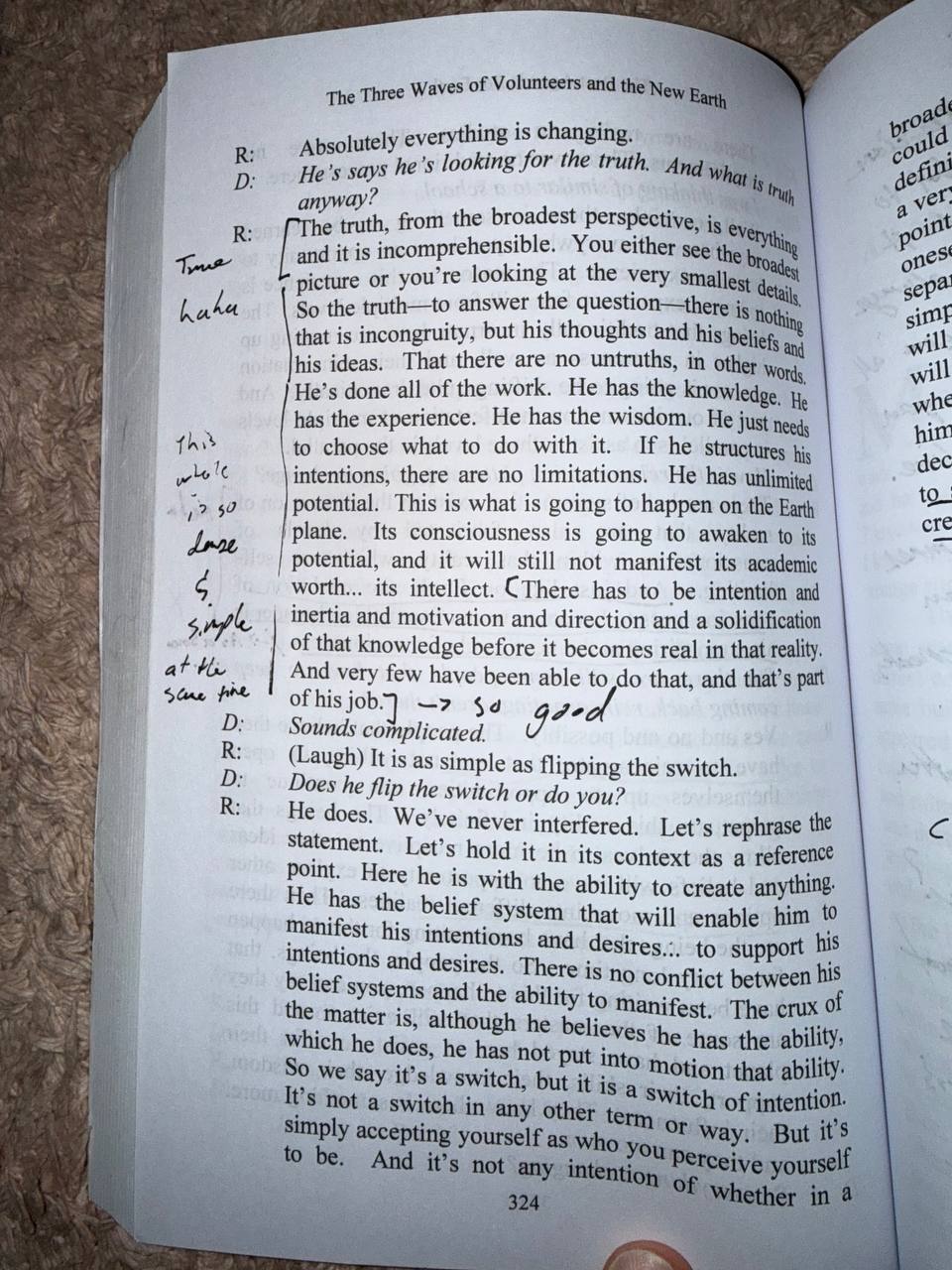
"The truth, from the broadest perspective, is everything and it is incomprehensible. You either see the broadest picture or you're looking at the very smallest details."
This passage highlights the dual nature of truth – both expansive and granular, emphasizing perception.
"So the truth—to answer the question—there is nothing that is incongruity, but his thoughts and his beliefs and his ideas. That there are no untruths, in other words."
This clarifies that truth isn't about objective correctness but about the alignment of one's thoughts and beliefs.
"He's done all of the work. He has the knowledge. He has the experience. He has the wisdom. He just needs to choose what to do with it."
This emphasizes personal readiness and the inherent capacity for manifestation.
"If he structures his intentions, there are no limitations. He has unlimited potential. This is what is going to happen on the Earth plane. Its consciousness is going to awaken to its potential, and it will still not manifest its academic worth... its intellect. [There has to be intention and inertia and motivation and direction and a solidification of that knowledge before it becomes real in that reality. And very few have been able to do that, and that's part of his job.]"
This section underlines the importance of active engagement and solidification of knowledge, beyond mere potential, to achieve real-world results. It contrasts passive knowledge with active manifestation.
"so good"
This is likely an emotional response to the preceding text.
"It is as simple as flipping the switch."
This simplifies the complex process of manifestation into a single, decisive action.
"He does."
This suggests that the 'switch' is internal and within one's own control.
"Let's rephrase the statement. Let's hold it in its context as a reference point. Here he is with the ability to create anything. He has the belief system that will enable him to manifest his intentions and desires... to support his intentions and desires."
This reinforces the idea that belief systems are foundational to creation and the fulfillment of intentions.
"There is no conflict between his belief systems and the ability to manifest."
This highlights the harmony between one's internal beliefs and external desires for manifestation.
"The crux of the matter is, although he believes he has the ability, which he does, he has not put into motion that ability."
This points out the critical gap between believing in one's ability and actually putting that ability into practice.
"So we say it's a switch, but it is a switch of intention."
This reframes manifestation as an internal act of intention rather than a literal external switch.
"It's not a switch in any other term or way. But it's simply accepting yourself as who you perceive yourself to be."
This offers a profound definition of the 'switch' as self-acceptance, linking it directly to the power of intention and manifestation.
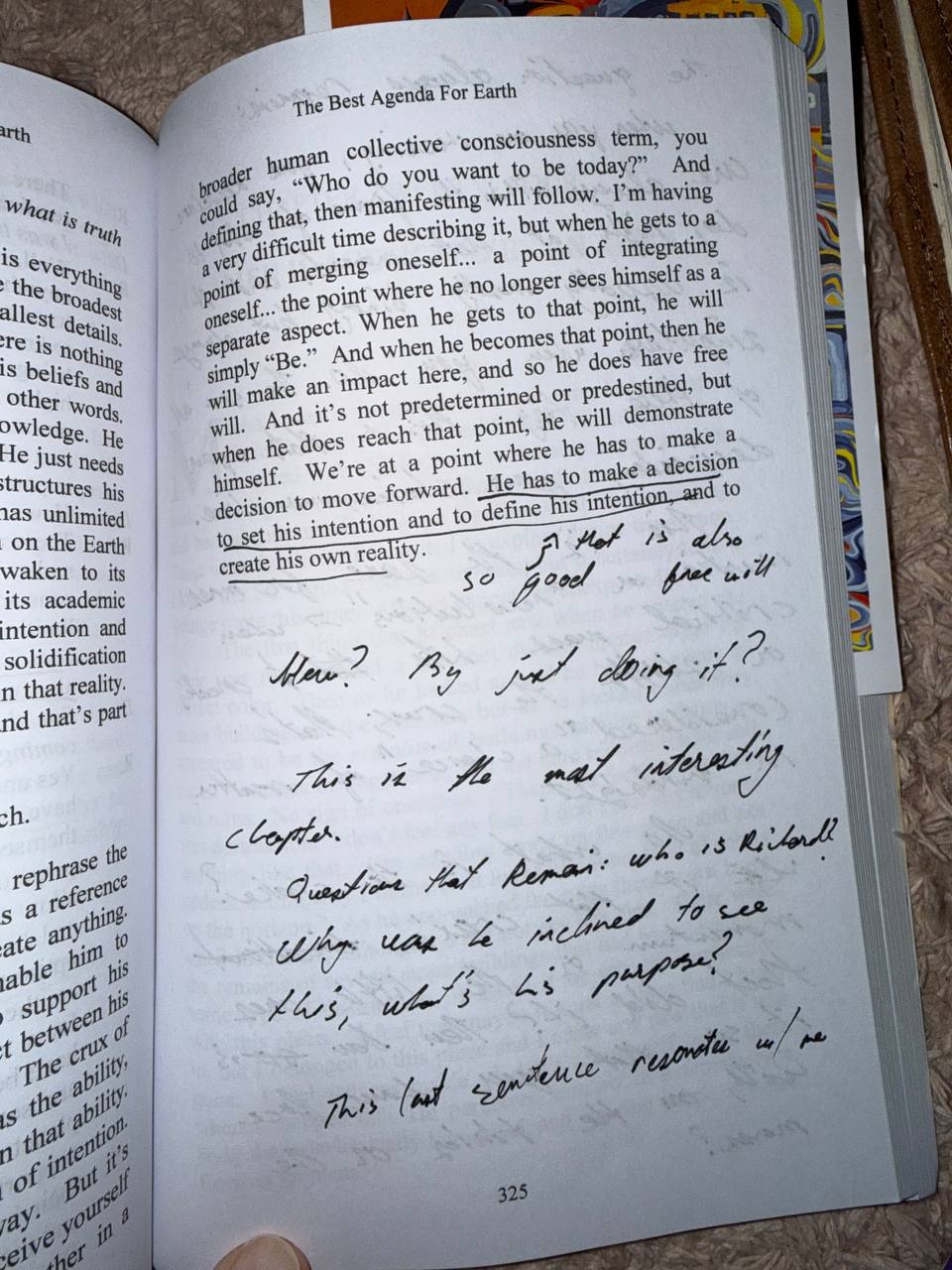
"He has to make a decision to set his intention and to define his intention, and to create his own reality."
This quote highlights the agency individuals have in shaping their reality through intentionality, echoing the reader's ponderings on how one actually 'does it' and the significance of such a concept.
Page Archive / Reading Artifacts
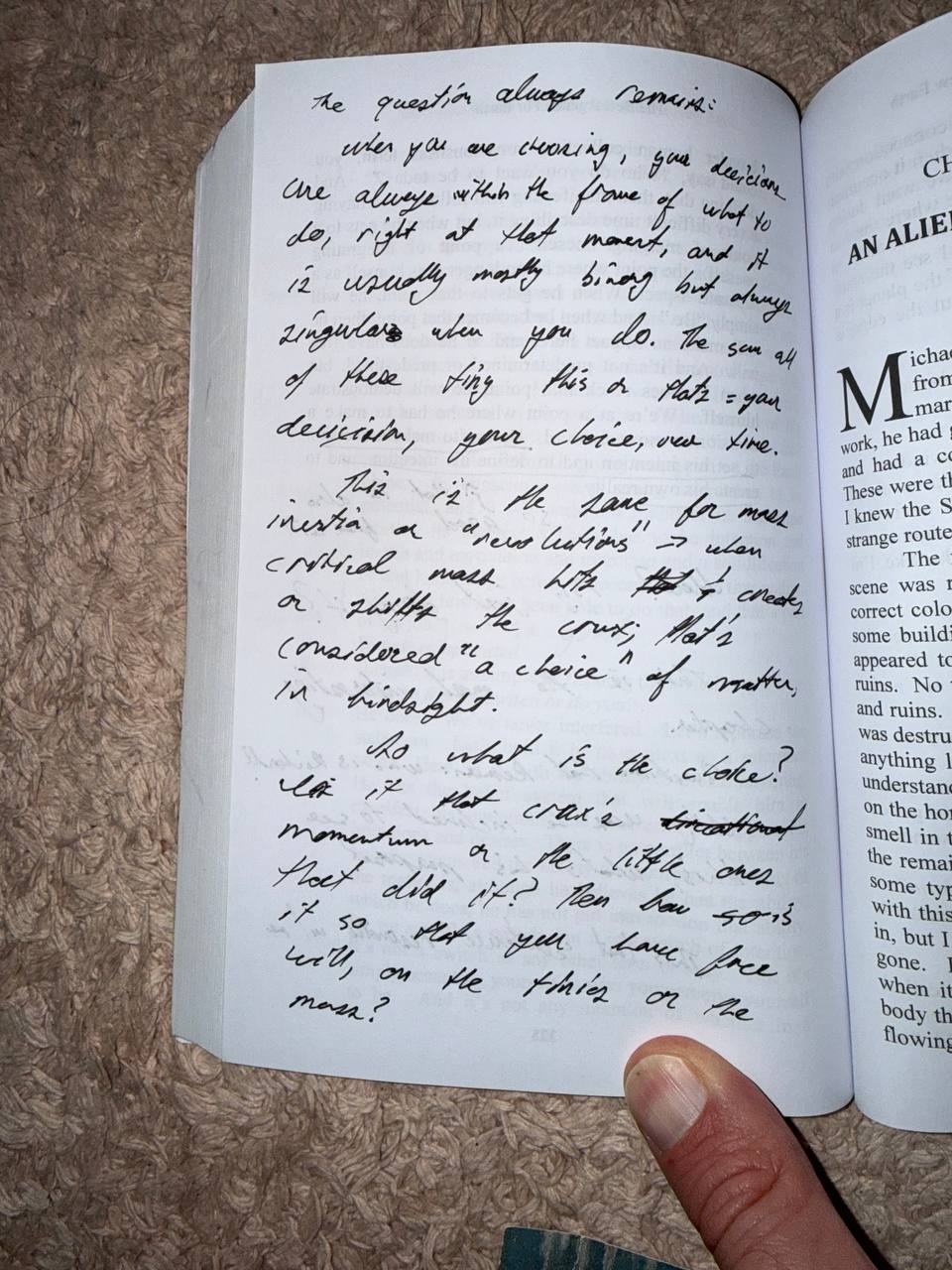
Keeping the uploaded pages here on the living link in a quiet way: not loud, not cluttered — just a visual archive of the exact pages that carried the charge.